


If you already have a 30-inch countertop cutout, you might assume that any 30-inch cooktop will fit. Unfortunately, it is not always that simple.
A cooktop’s advertised width and the size of the opening required in your countertop are two different measurements. A cooktop may be sold as a 30-inch model while its actual cutout requirements are smaller and those dimensions can vary from one manufacturer or model to another.
So before you order a new cooktop, the important question isn’t just, “Is this a 30-inch cooktop?”
It’s “Does this specific cooktop fit my existing cutout?”
This guide explains what to measure, what “30-inch cooktop” really means, and how to check compatibility before you buy.
What Does a 30-Inch Cooktop Actually Mean?
When a cooktop is described as a 30-inch cooktop, the 30 inches generally refers to its approximate overall width or product class.
It does not necessarily mean that the countertop opening should be exactly 30 inches wide.
The appliance sits on top of the countertop, while the body of the cooktop extends into the cutout below. Because of this, the required opening is typically smaller than the cooktop’s overall dimensions.
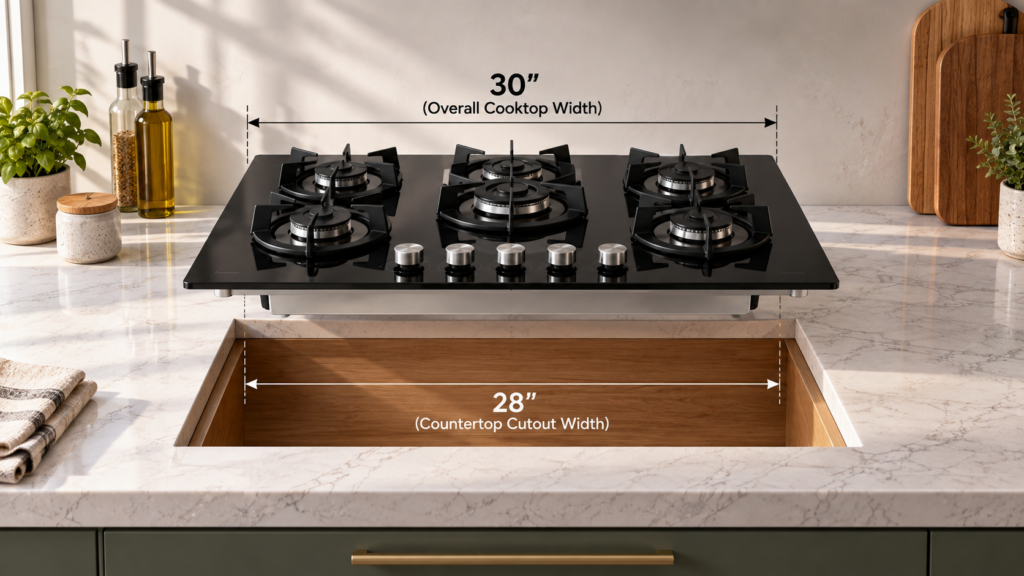
For example, a cooktop marketed as 30 inches wide may require a countertop cutout that is several inches narrower. The exact requirement depends on the specific model.
That is why using the product’s advertised width alone is not enough to determine whether it will fit your countertop.
Will a 30-Inch Cooktop Fit a 30-Inch Cutout?
Not necessarily.
If you have a countertop opening that you consider a “30-inch cutout,” don’t assume that every 30-inch cooktop will fit.
There are actually two separate measurements you need to consider:
- Cooktop overall dimensions — the size of the appliance visible above the counter
- Cutout dimensions — the size of the opening required in the countertop
The manufacturer’s installation specifications are what ultimately determine compatibility.
NOTE: Cutout dimensions can vary between cooktop models, even when the products are marketed as the same nominal size. Always check the installation requirements for the exact model before purchasing.
This is especially important when you’re replacing an existing cooktop and want to avoid modifying your countertop.
Why the Cooktop Is Usually Larger Than the Cutout
A built-in cooktop is designed to sit over the countertop opening. Its top surface needs to overlap the edges of the cutout so the appliance can rest securely on the counter.
That’s why the visible cooktop can be wider than the opening underneath it.
Think of it this way:
Overall cooktop width ≠ countertop cutout width
The countertop opening needs to accommodate the portion of the appliance that sits inside the counter, while the top surface remains supported by the countertop.
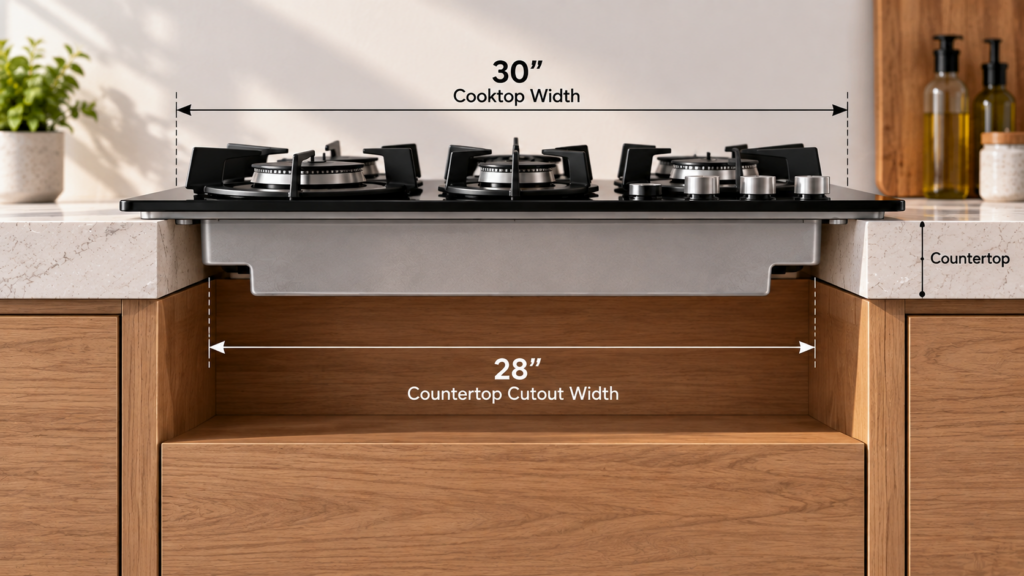
This distinction is one of the most important things to understand before replacing a cooktop.
What Measurements Should You Check?
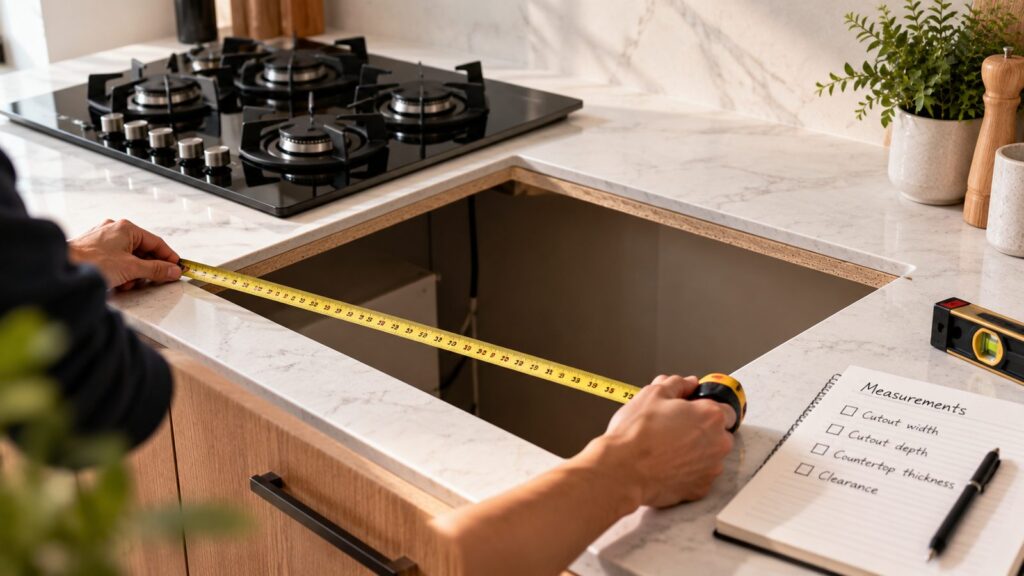
Before shopping for a replacement, measure your existing countertop opening carefully.
1. Cutout Width
Measure the opening from one inside edge to the opposite inside edge.
Don’t measure the entire countertop or the outside edge of the old cooktop.
2. Cutout Depth
Measure the opening from the front inside edge to the back inside edge.
Depth can be just as important as width because the new cooktop needs enough room to fit into the existing opening.
3. Countertop Thickness
Check how thick your countertop is where the cooktop will be installed.
The manufacturer’s specifications may include minimum or maximum countertop thickness requirements.
4. Clearance Around the Cooktop
Look at what is underneath and around the existing opening.
Check for:
- Drawers
- Cabinets
- Oven components
- Electrical connections
- Gas lines
- Structural supports
A cooktop can have the correct cutout dimensions and still require additional clearance underneath.
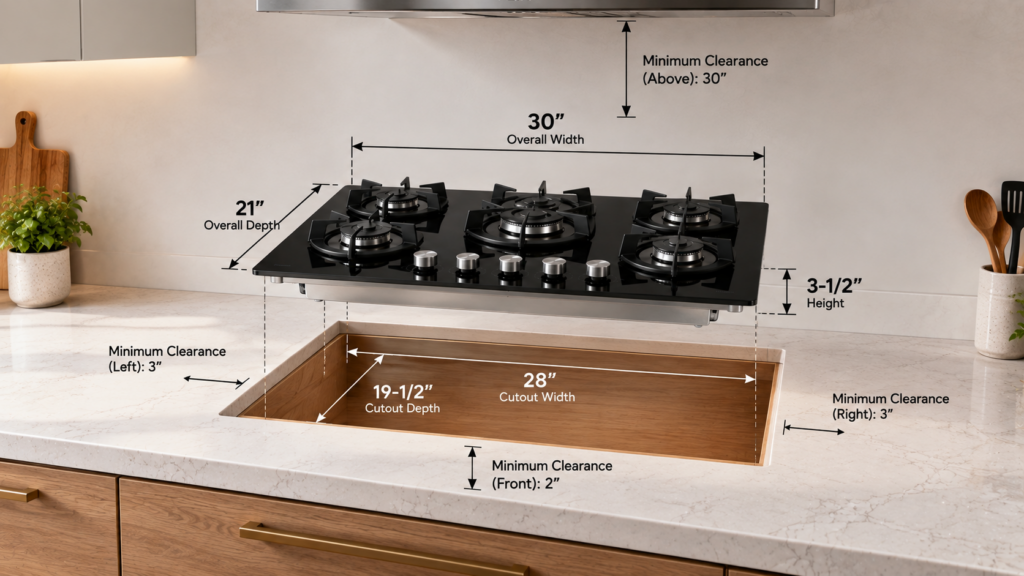
TIPS: Measure the existing countertop opening before shopping, then compare those measurements directly with the new cooktop’s installation specifications.
Don’t Measure Only the Old Cooktop
If you’re replacing an existing cooktop, it can be tempting to measure the appliance itself and buy another cooktop with the same advertised size.
That’s risky.
Two cooktops can both be labeled 30-inch cooktops but have different overall dimensions and different cutout requirements.
Instead, measure the countertop opening after removing the old unit, if possible. This gives you the actual dimensions you need to work with.
If the old cooktop is still installed and you’re not comfortable removing it, use the existing manufacturer’s installation information if available, but verify the countertop opening before ordering the replacement.
What About Gas, Electric, and Induction Cooktops?
The same basic sizing principle applies to different cooktop types, but their installation requirements can differ.
30-Inch Gas Cooktop
A gas cooktop may require space for gas connections beneath the countertop and may have specific clearance requirements around combustible materials.
If you’re replacing another gas cooktop, check whether the new model’s gas connection and installation requirements work with your existing setup.
30-Inch Electric Cooktop
Electric cooktops require the appropriate electrical supply and may have specific electrical installation requirements.
The cutout size is only one part of compatibility. You also need to confirm that your home’s electrical setup meets the cooktop’s requirements.
30-Inch Induction Cooktop
Induction cooktops can have different ventilation, clearance, and electrical requirements depending on the model.
Even if an induction cooktop fits the same countertop opening as your existing cooktop, you should still verify the installation specifications and electrical requirements.
NOTE: Switching from gas to electric or induction may require changes to your home’s utilities or electrical service. Check the manufacturer’s installation requirements and consult a qualified professional when modifications are needed.
How to Find the Exact Cutout Dimensions
The most reliable place to find the required cutout dimensions is the cooktop’s installation guide or specification sheet.
Look for terms such as:
- Cutout Width
- Cutout Depth
- Required Cutout Dimensions
- Installation Dimensions
- Countertop Cutout
- Minimum Clearance
Don’t rely only on the product title, listing headline, or “30-inch” description.
The installation diagram is usually much more useful because it shows the exact opening and clearance requirements for that model.
What If Your Existing Cutout Doesn’t Match?
This is where your options depend on how much the dimensions differ.
If the New Cooktop Requires a Smaller Opening
A smaller cutout may sometimes be easier to work with because the countertop opening could potentially be modified to accommodate the appliance, depending on the situation.
However, don’t assume the difference can be solved simply by adding a trim piece or filler.
If the New Cooktop Requires a Larger Opening
A larger cutout may require cutting or modifying the countertop.
This can be more complicated, particularly with stone, quartz, granite, or other finished countertop materials.
If the Cutout Is Very Different
Instead of modifying the countertop, it may be easier to choose another cooktop with installation dimensions that are compatible with the existing opening.
TIPS: If avoiding countertop modification is important to you, shop by required cutout dimensions rather than by the advertised cooktop width alone.
Can You Replace a 30-Inch Cooktop With Another 30-Inch Cooktop?
Often, a same-size replacement can be a straightforward option—but you still need to verify the dimensions.
Before ordering, compare:
| What to Compare | Why It Matters |
| Overall width | Determines how the cooktop sits on the counter |
| Cutout width | Determines whether it fits the existing opening |
| Overall depth | Ensures the appliance fits the available space |
| Cutout depth | Ensures the body fits inside the counter |
| Countertop thickness | Confirms mounting compatibility |
| Required clearance | Prevents conflicts with cabinets and appliances |
| Gas or electrical requirements | Confirms utility compatibility |
A replacement cooktop that matches your existing cutout can save you from unnecessary countertop work.
A Simple Way to Check Cooktop Compatibility
Before you buy, follow this process:
Step 1: Measure your existing cutout.
Record the width and depth of the countertop opening.
Step 2: Measure the surrounding space.
Check the countertop area around the opening and the space underneath.
Step 3: Choose the cooktop size you want.
If you’re replacing a standard cooktop, a 30-inch model may be the natural starting point.
Step 4: Find the manufacturer’s installation specifications.
Look specifically for the required cutout dimensions.
Step 5: Compare the numbers.
Make sure your existing opening meets the new cooktop’s requirements.
Step 6: Check utility requirements.
Confirm the gas connection or electrical requirements before purchasing.
Step 7: Check clearance requirements.
Make sure cabinets, drawers, walls, and appliances don’t interfere with the installation.
This approach is much safer than assuming that two appliances with the same advertised width will have identical installation requirements.
What If You’re Designing a New Countertop?
If you’re installing a new countertop, you have more flexibility.
In that situation, it’s usually best to choose the cooktop first and cut the countertop according to the manufacturer’s installation specifications.
That way, the countertop opening is designed specifically for the appliance rather than trying to find an appliance that fits an existing opening.
TIPS: For a new countertop installation, finalize the cooktop model before the countertop is cut so the fabricator can work from the manufacturer’s exact specifications.
Before You Buy: 30-Inch Cooktop Fit Checklist
Use this checklist before ordering:
- Measured the existing cutout width
- Measured the existing cutout depth
- Checked countertop thickness
- Checked available space underneath
- Confirmed the cooktop’s required cutout dimensions
- Checked front, rear, and side clearances
- Confirmed gas or electrical requirements
- Checked cabinet and drawer clearance
- Reviewed the manufacturer’s installation instructions
- Confirmed whether countertop modification will be necessary
Ready to Find a Cooktop That Fits Your Space?
Once you know your countertop cutout dimensions, you can shop with much more confidence. Instead of choosing a cooktop based only on its advertised width, compare the actual installation specifications to your available space.
Final Thoughts
A 30-inch cooktop is not automatically designed for every 30-inch countertop opening. The term “30-inch” generally describes the cooktop’s size category, while the actual countertop cutout requirements depend on the individual model.
If you’re replacing an existing cooktop, start by measuring the cutout width and depth. Then compare those measurements with the exact installation specifications of the cooktop you’re considering.
For a new countertop, choose the cooktop first and have the opening made according to its manufacturer-specified dimensions.
The simplest rule to remember is:
Don’t buy based on cooktop width alone. Buy based on verified cutout compatibility.
