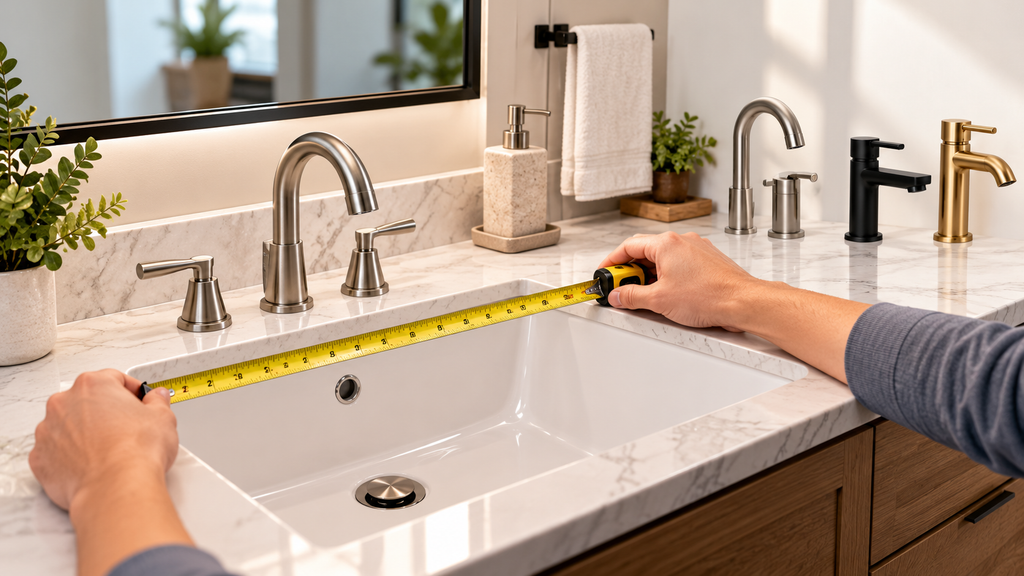
It is more than choosing a bathroom faucet you like; it’s about choosing the right size for your bathroom. The faucet must also be compatible with the mounting holes of your sink, extend comfortably over the basin, and offer sufficient clearance for everyday use.
Although a faucet may appear to be a perfect fit online, it might not fit if it is not the same click size on the spout, if the handles don’t fit the backsplash, or if the mounting type is not suitable for your sink.
Prior to purchasing a new faucet, make some measurements to narrow down your choices. This guide will help you to measure your bathroom sink so you select the faucet that fits best, understand what each most important measurement is, and some things to look out for before you choose your faucet.
What to measure before you select a bathroom faucet?
First, note the type of your sink and the position of the faucet hole on your sink. Then take measurements of characteristics that will impact faucet compatibility and day-to-day usability.
These are the important measurements to take:
- Faucet hole spacing: Distance between the centers of the holes.
- Hole Diameter: Diameter of the hole for installing the faucet or handles.
- Faucet height: The distance from the mounting surface to the outlet of the faucet.
- Spout reach: The distance the spout will cover horizontally above the sink.
- Backsplash clearance: Space behind the faucet for handles and installation.
- Surface thickness: The thickness of the sink deck or countertop that the faucet is mounted to.
Next, we have listed a few measurements to allow you to compare faucet specifications to the actual faucet in your sink, not just looking at them. The instructions to install the device from the manufacturer should always be consulted before buying.
#Step: 1- Determine your bathroom sink and faucet mounting type
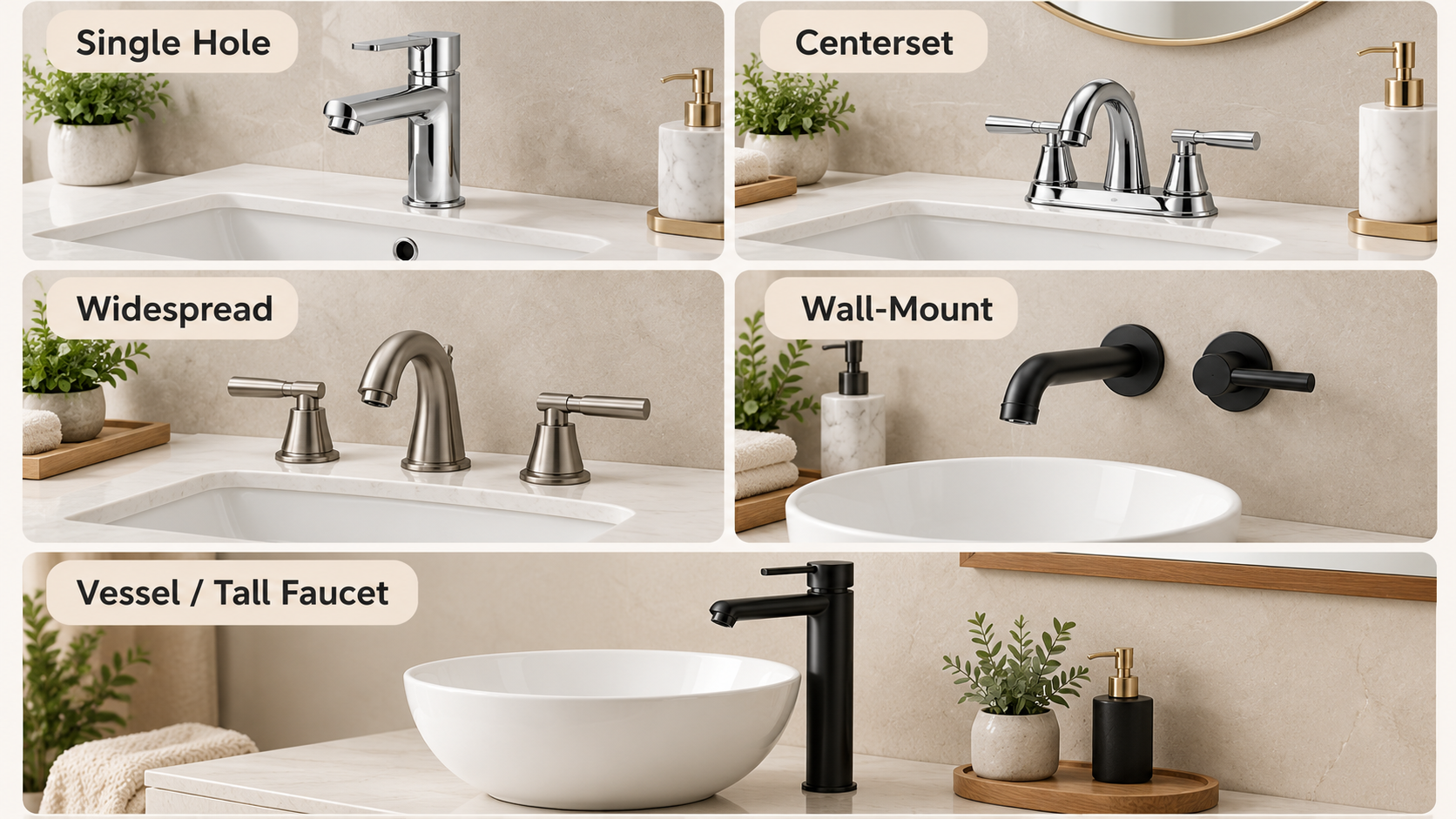
Prior to measuring individual dimensions, find out how your existing faucet is installed. The mounting method can help to identify potential replacement styles.
1. Single-hole faucets
A one-hole faucet has one hole for the faucet body and handle assembly. A practical solution for small or simple bathroom vanities.
Determine the diameter of the opening and assess the space in the vicinity of the opening. When replacing an existing faucet, be sure the base plate fits tightly, and the mounting hardware of the new faucet will fit in the sink.
2. Centerset faucets
A centerset faucet usually has a spout and handles that are all mounted on one assembly for a small space installation. Most traditional faucets with the center cut-out have three holes with a gap of about 4 inches between the center of the outer holes.
The details of the hole configuration and dimensions may vary depending on the model. Before replacing, consult the manufacturer’s installation instructions.
3. Widespread faucets
Widespread faucets are designed to feature a detachable handle and a detachable spout to provide greater flexibility in installing them. Many people opt for a broader mounting setup, typically about 8″ or more apart between the outermost mounting-hole centers.
Be sure to measure the current hole spacing and check the faucet’s allowable installation specifications.
4. Wall-mounted faucets
Wall-mounted faucets have a plumbing connection to a hole in the wall and not in the sink or countertop.
For such faucets, the horizontal distance from one plumbing connection to another, the vertical distance from the sink to the top of the faucet, and the distance from the wall to the faucet basin are measured. Check the manufacturer’s requirements for mounting and the faucet’s compatibility with your sink.
#Step: 2- Measure the Faucet Hole Spacing
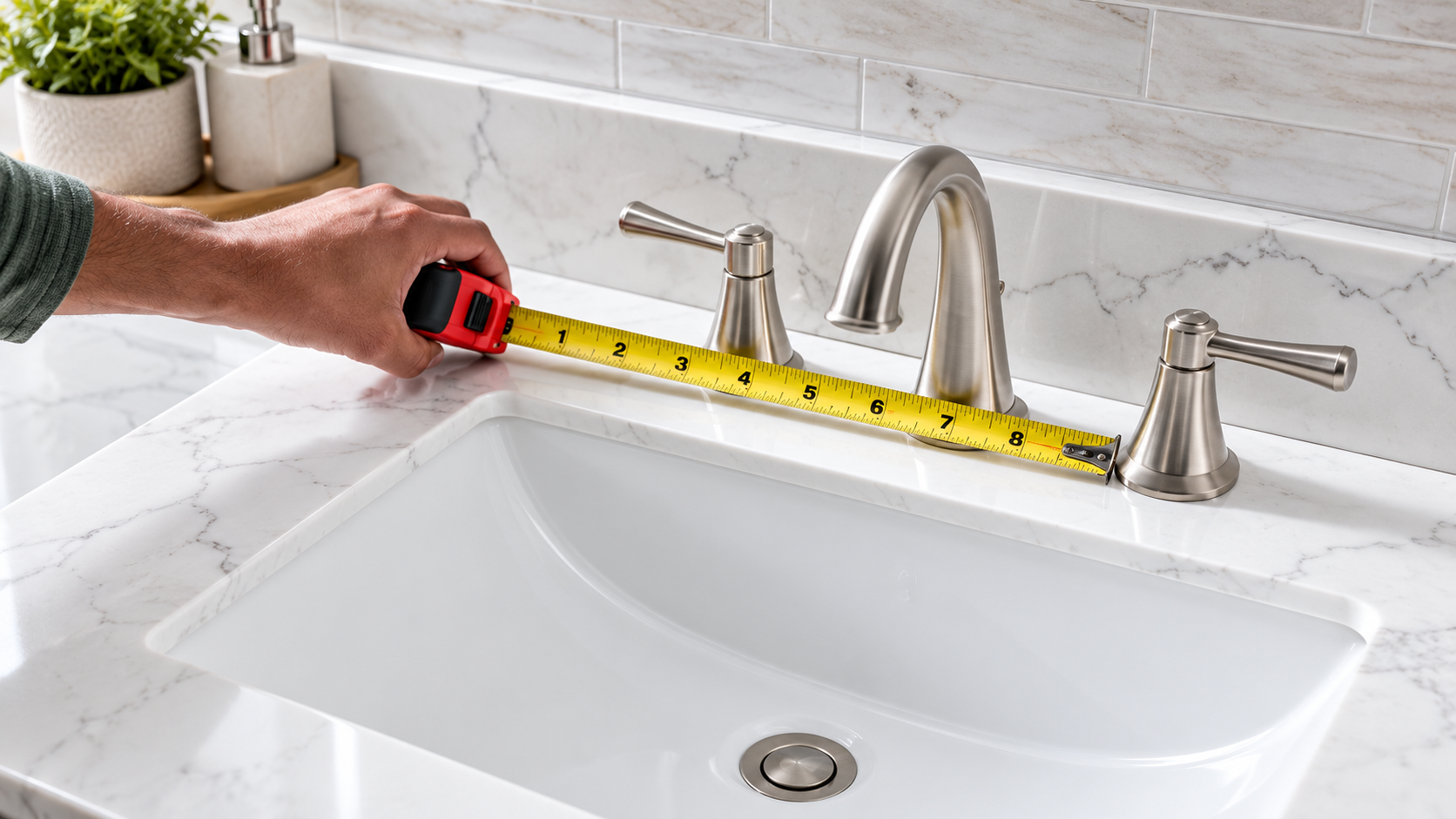
Replacing an existing bathroom faucet is one of the most crucial measurements you will need for replacing the faucet in your bathroom, which is called the faucet hole spacing. Possibly additional work will be necessary if the mounting arrangement is not identical to the new faucet.
Follow these steps:
- Count the number of faucet holes on the sink deck or countertop behind the sink.
- If the faucet is installed, the distance between the centres of the mounting parts is used as a reference point at the start.
- If it is possible to remove the faucet, take the measurement from the center of one mounting hole to the center of the other for a more accurate measurement.
- For a three-hole setup, write down the distance from the outer hole centres and the distance between each hole.
- Check with the faucet manufacturer’s installation instructions.
- Do not use size from the outside of the handles or decorative base plates as a measurement. The dimensions shown do not necessarily correspond to the mounting-hole spacing.
- When installing a new three-hole faucet on a deck plate with just one hole, determine if the new faucet can be used with the existing deck plate that will cover the unused holes.
| Note: Not all of the faucets labeled as centerset or widespread will fit your sink. Check hole spacing, hole diameter and mounting specifications before ordering. |
#Step: 3- Measure the height of the faucets
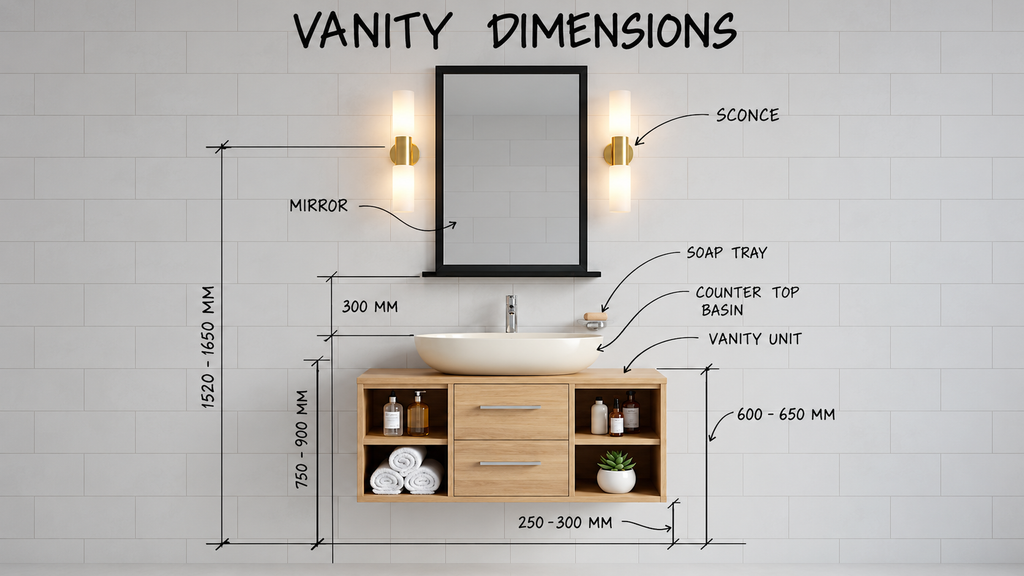
The height of the faucet will impact ease of use of the sink and will determine
if it will fit under a mirror, cabinet, or shelf.
Measure the distance from the faucet mounting surface to the lowest obstruction above the faucet to determine the available space. Then check the overall height and installation drawing of the selected faucet to compare with that measurement.
Consider these factors:
- Mirror clearance: Check to see if the faucet and handles will interfere with the mirror and frame.
- Cabinet clearance: See if there is a height clearance issue due to overhead cabinets or shelves.
- Basin depth: The depth of the basin or vessel sink may need a different configuration of the faucet.
- Everyday use: Spout should offer areas for practical handwashing clearance without awkward stream position.
When the vessel sink is positioned above the countertop, be especially aware of the position of the faucet’s outlet with respect to the top of the sink. Taller or lower faucets than the sink may not drain the sink, and the faucet may be at an inappropriate height and reach, which can lead to splashing.
#Step 4: Take the Faucet Spout Reach Measurement
Spout reach is the distance from the spout mounting reference point to the water outlet horizontally. It is useful to determine where the water will drop within the basin.
If the spout isn’t long enough, it doesn’t fit into the mounting holes and can be uncomfortable to use on a faucet.
To check the fit:
- Determine the location of the centerline of the faucet, or the mounting point indicated in the product drawing.
- Take this point and measure the distance to the inside of the sink.
- Find the back edge, front edge, and drain of the basin.
- You can compare these positions with the faucet’s faucet head reach.
- Verify that the water stream will not hit the back wall or the rim of the basin area in use.
- Reach should NOT be the only criteria used to choose a faucet. The orientation and placement of the outlet of the spout also influence the water flow.
For instance, a shallow rectangular basin can require a different spout design compared to a deep, rounded vessel sink. These depend on the size of the basin and the faucet.
For additional guidance, consult Moen’s explanation of bathroom faucet reach dimensions.
Step 5: Check the Mounting Surface and Available Space
When installing the unit, it is important to inspect the mounting surface and available space in order to ensure safe and proper installation.
While the hole spacing, height, and reach might seem to be just right, the faucet must be physically compatible with the sink or countertop.
When buying, make sure you check the following:
1. Hole diameter
If possible, measure the diameter of every opening that is already there. Check with the faucet manufacturer’s allowed hole size.
If it will not fit in the opening, the mounting hardware will not fit. If it is too large, the opening may not seal or be covered properly.
2. Countertop thickness
Determine the thickness of a sink deck or countertop where the faucet will be installed. Ensure that the faucet mounting hardware fits the faucet.
3. Backsplash clearance
Check the distance between the faucet mounting position and the backsplash or wall. Ensure that the handles can move in the range of motion that they are designed to do without getting stuck.
4. Underneath the sink
Check under the countertop for obstructions, such as drawers, cabinet supports, plumbing connections, etc. There must be sufficient space available for mounting the faucets, supply lines, and drain parts and for future maintenance.
If the holes need to be drilled or altered in the countertop, please call the sink or countertop manufacturer and a qualified installer before attempting the job.
Common Mistakes to Avoid When Measuring for a Bathroom Faucet
There are a few simple checks that can help to prevent an inappropriate purchase.
- Overall width only: The overall size does not determine a faucet’s mounting configuration. For hole spacing edge to edge: use centre-to-centre measurements.
- Failure to consider spout reach: A faucet could be installed into the holes, but may be too near the back wall or front rim.
- For vessel sink height: The faucet outlet should be measured from the bottom of the basin, not from the countertop.
- Don’t overlook the backsplash: Handles must have enough operating clearance.
- Overlooking the specifications of the product: Verify the hole diameter, mounting range, and installation conditions for the specific model.
Make a few minutes disappear before going shopping and record these measurements, and you should be able to limit down to a few potentially compatible faucets, and the installation changes will be minimised.
Checklist for measuring bathroom faucets
Here is a checklist to help you make sure you have the key faucet details before you select your faucet.
- Determine the type of sink and the manner in which the faucets are mounted.
- Check the number of existing holes for mounting.
- Write down the spacing between the centres.
- Take measurements of the hole and countertop thickness.
- Look for the height of the faucets and the overhead clearance.
- Compare spout reach with the basin’s dimensions.
- Check backsplash and handle clearance.
- Review the manufacturer’s installation instructions.
- Look under the sink for space.
Frequently Asked Questions
-
What are the dimensions of a sink?
First, figure out the type of mount for the faucets and how many holes are on the faucet currently. Determine the spacing, hole diameter, and thickness of the mounting surface between the centers. Before buying, review the height of the faucet, the reach of the faucet’s spout, and the distance between the faucet and the backsplash.
-
What is the distance between bathroom faucet holes?
The spacing will vary according to the faucet configuration. Many centerset faucets measure approximately 4” from outside hole to outside hole, and most commonly, widespread faucets have wider spaces from outside hole to outside hole. Always check the exact dimensions that the manufacturer of the faucets calls for.
-
What size of faucets will fit my bathroom sink?
Check the mounting holes on your sink to the faucet’s installation requirements. Also consider the height of the outlet, reach of the spout, the shape of the basin, and clearance. The right faucet needs to fit the mounting and be used in the sink comfortably.
-
May use a single-hole faucet instead of a three-hole faucet?
In some cases, yes. Unused holes can be covered with a compatible deck plate, but the deck plate must be compatible with the sink hole pattern and the installation requirements for the faucet. Check for compatibility before buying.
-
Should the sink in a bathroom be deeper, should the sink’s faucet be taller?
Not necessarily. This is just one factor to consider. The height of the faucet’s outlet, the reach of the faucet spout, the angle of the faucet outlet, and the overall shape of the sink all affect the ease with which the faucet operates. Compare specifications before buying, with the actual faucet for the basin.
-
How to choose the perfect bathroom faucet for your sink?
The bathroom faucet that fits your sink mounting system, the comfortable space for hand washing, and the direction of water flow into the sink. Before buying, take measurements of hole spacing, faucet height, spout reach, and the space available to install the faucet to make an educated decision.
-
Looking for a bathroom faucet to install?
Check out different faucet styles and specifications for Mardey bathroom faucets and choose one that will fit in with your sink and bathroom design.