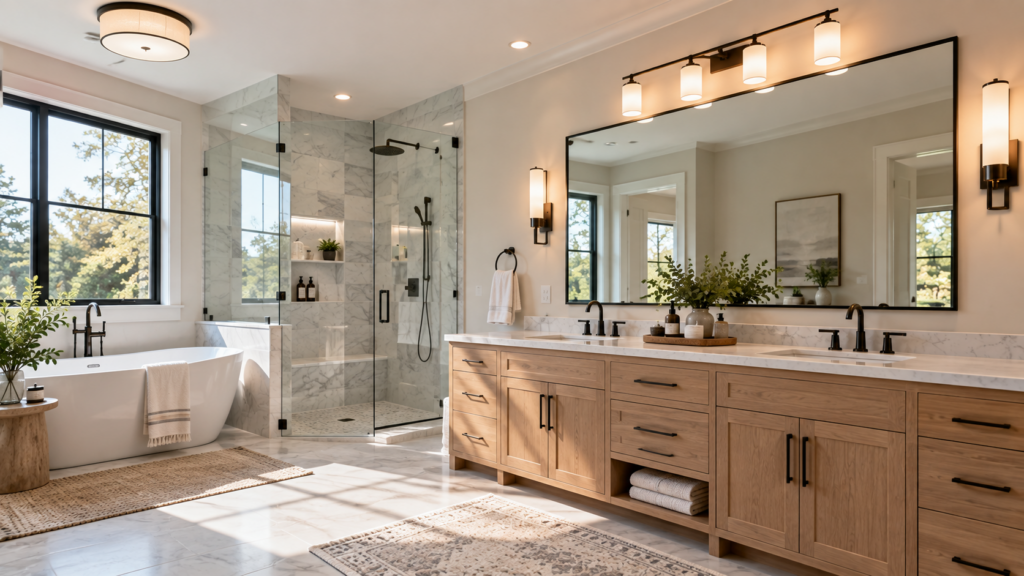
The right bathroom lighting does more than make the room look brighter. It affects how clearly you see your face in the mirror, how comfortable the bathroom feels, and how well different areas of the room are illuminated.
So, what is the best bathroom lighting for your home? The answer depends on your bathroom size, vanity setup, mirror, ceiling height, natural light, and how you use the space.
Instead of choosing one attractive fixture and hoping it works, it is better to think about where you need light and what you need that light to do.
What Is the Best Bathroom Lighting for Your Space?
There is no single bathroom light that works equally well in every bathroom.
A small powder room may need a well-positioned vanity fixture and a ceiling light. A larger bathroom with a double vanity, shower, and tub may need several layers of lighting.
A practical bathroom lighting setup usually combines:
- Task lighting around the vanity and mirror for grooming
- Ambient lighting from ceiling fixtures for general illumination
- Accent or decorative lighting where you want additional visual interest
The goal is not simply to make the bathroom bright. The goal is to make sure the right areas are illuminated without creating harsh shadows or overly bright spots.
Start With the Bathroom Area You Need to Light
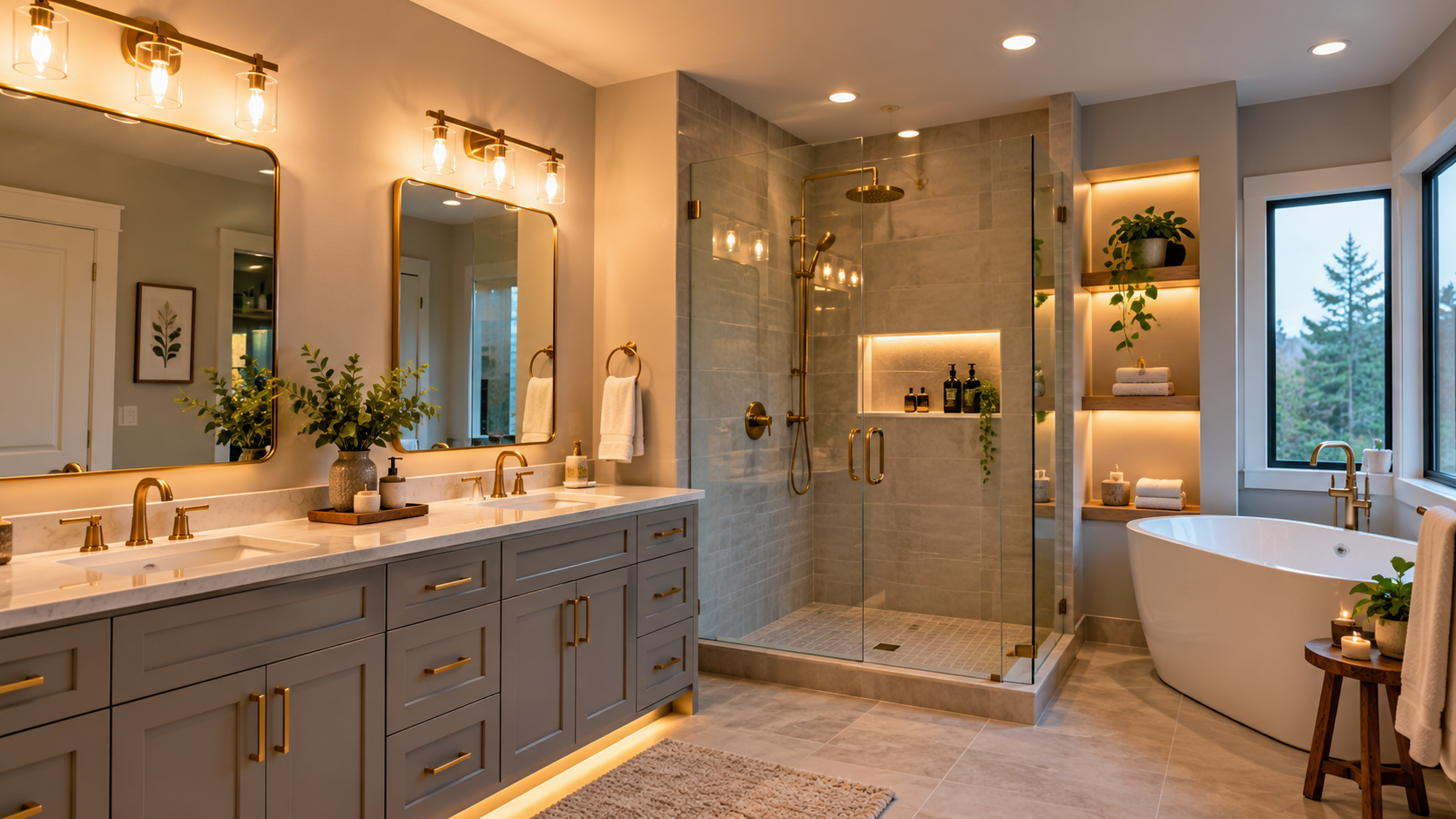
Before choosing a fixture, look at your bathroom as several lighting zones rather than one room.
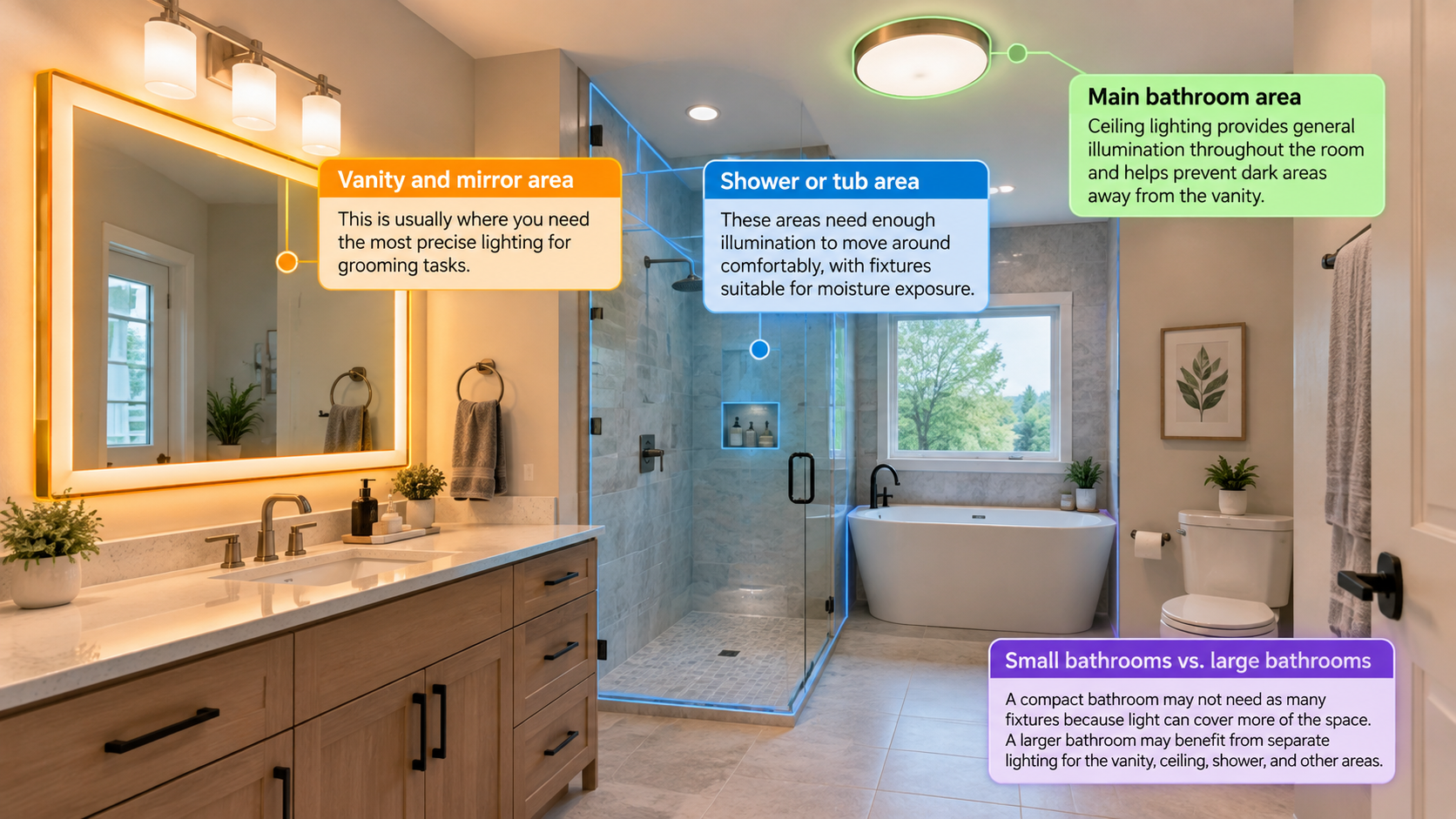
Vanity and mirror area
This is usually where you need the most precise lighting. You may use the mirror for shaving, applying makeup, styling your hair, or other grooming tasks.
Shower or tub area
These areas need enough illumination to move around comfortably, but the fixture must also be appropriate for its location and moisture exposure.
Main bathroom area
Ceiling lighting provides general illumination throughout the room and helps prevent dark areas away from the vanity.
Small bathrooms vs. large bathrooms
A compact bathroom may not need as many fixtures because light can cover more of the space. A larger bathroom may benefit from separate lighting for the vanity, ceiling, shower, and other areas.
Thinking about these zones first helps you avoid the common mistake of trying to make one fixture do everything.
What Is the Best Lighting for a Bathroom Mirror?
The mirror is one of the most important places to get bathroom lighting right.
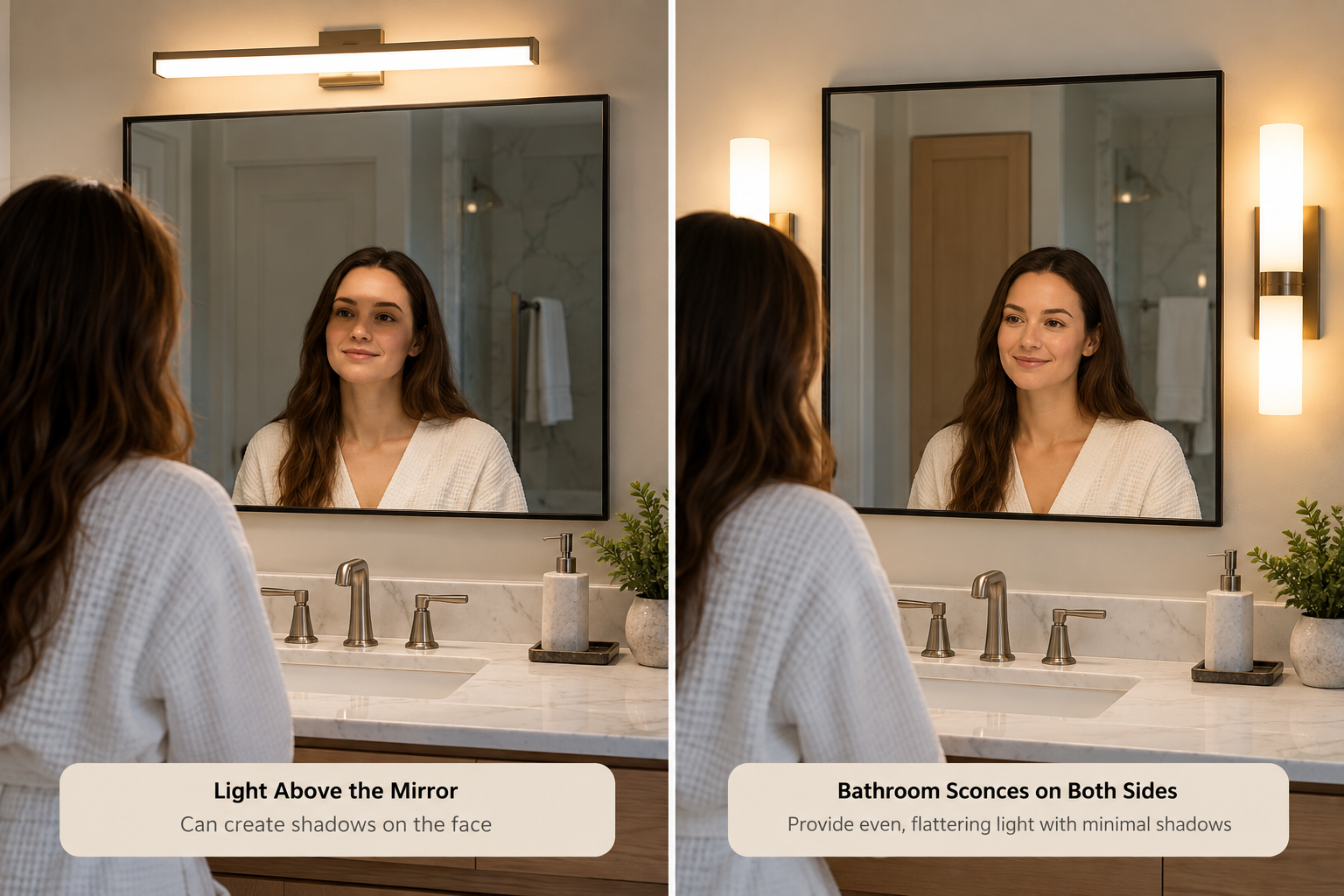
A light positioned directly above a mirror can illuminate the face, but depending on its position and design, it can also create shadows under the eyes, nose, or chin.
This is why bathroom sconces placed on the sides of the mirror can be useful. Light coming from both sides can provide more even illumination across the face.
Bathroom lights over mirror
An over-mirror fixture can work well when it is appropriately sized for the mirror and vanity. It is also a practical option when wall space beside the mirror is limited.
However, the fixture should not be selected based only on appearance. Consider:
- The width of the mirror
- The width of the vanity
- The height of the mounting location
- How evenly the fixture distributes light
Bathroom sconces beside the mirror
Pairing sconces on both sides of the mirror is another common approach. This can provide balanced task lighting and can also add a decorative element to the bathroom.
For a new installation, think about the mirror, faucet, vanity, and lighting together rather than selecting each item separately.
If you’re also choosing a faucet for the same vanity, our guide on how to choose a bathroom faucet can help you compare faucet types, sizes, and installation considerations.
How to Choose Vanity Bathroom Lighting
Your vanity lighting should match the way you actually use the bathroom.
For a single vanity, one appropriately sized fixture may be enough. A wider or double vanity may require a larger fixture or multiple light sources to provide more even coverage.
Consider the vanity width
A fixture that is too small can look out of proportion and may not provide enough coverage. A fixture that is much wider than the vanity can dominate the space.
The mirror also matters. If the mirror is significantly narrower or wider than the vanity, the relationship between the mirror and light fixture should be considered before installation.
Think about what happens in front of the mirror
If the bathroom is primarily used for quick everyday routines, you may need straightforward task lighting.
If it is used for detailed grooming, makeup, shaving, or styling, more even light around the face becomes particularly important.
The best vanity bathroom lighting is therefore not simply the brightest option. It is lighting that gives you enough visibility without creating uncomfortable glare or distracting shadows.
When Should You Choose Bathroom Sconces Instead of Over-Mirror Lighting?
If you’re deciding between sconces and a fixture above the mirror, consider both the layout and the type of lighting you need.
Sconces can be useful when:
- You want more balanced light around the face
- There is enough wall space beside the mirror
- You want the lighting to become part of the bathroom’s design
- The mirror and vanity layout allows symmetrical placement
An over-mirror fixture can be practical when:
- Wall space beside the mirror is limited
- You prefer a simpler installation
- The mirror and fixture can be properly proportioned
- You want to keep the wall area visually clean
There is no universal winner. The right choice depends on the dimensions and layout of your vanity area.
Once your lighting and faucet are selected, coordinating your bathroom accessories with the faucet can help create a more cohesive look. See our guide on how to match bathroom accessories with your faucet.
Do You Need a Bathroom Ceiling Light?
A vanity light does not necessarily replace the need for general bathroom lighting.
Imagine standing in front of a well-lit mirror while the rest of the bathroom remains relatively dark. The vanity area may look fine, but the shower, tub, floor, or corners of the room can still feel underlit.
A bathroom ceiling light helps provide general illumination across the room.
This becomes especially useful in:
- Medium and large bathrooms
- Bathrooms with limited natural light
- Bathrooms with separate shower or tub areas
- Spaces where the vanity light does not illuminate the rest of the room
For a small bathroom with good natural light, the lighting requirements may be simpler. But for many bathrooms, combining vanity lighting with a ceiling fixture creates a more balanced result.
How to Choose Bathroom Ceiling Light Fixtures
Once you decide that you need a ceiling fixture, look beyond its style.
Consider ceiling height
A low ceiling may work better with a low-profile flush-mount fixture rather than a fixture that hangs down significantly.
Higher ceilings give you more flexibility, but the fixture should still distribute light effectively throughout the room.
Consider bathroom size
A small bathroom does not necessarily need a large ceiling fixture. Conversely, a single small fixture may not provide enough coverage in a large bathroom.
Consider light distribution
The fixture should illuminate the room rather than creating one extremely bright spot surrounded by darker areas.
Recessed lighting can also be useful in some bathroom layouts, particularly when a clean, low-profile appearance is desired.
Is Bathroom Hanging Pendant Lighting a Good Idea?
Pendant lighting can add a strong design element to a bathroom, particularly around a vanity.
But it is not simply a matter of finding a pendant you like and hanging it wherever there is space.
Before choosing bathroom hanging pendant lighting, consider:
- Ceiling height
- Pendant size
- Where the fixture will hang
- How much the fixture extends downward
- Whether the fixture is properly rated for its intended location
- Whether it interferes with movement or the use of the mirror
Pendant lighting can work especially well in bathrooms with enough vertical and visual space. In a compact bathroom or a low-ceiling space, a flush or low-profile fixture may be more practical.
How Bright Should Bathroom Lighting Be?
Brightness is another area where homeowners often focus too much on bulb wattage.
Today, lumens are a more useful way to understand how much light a bulb or fixture produces. Watts primarily describe energy consumption rather than the amount of visible light.
The right brightness depends on the size of the bathroom and the job the light needs to perform.
For example, task lighting around a vanity needs to provide clear visibility, while general ceiling lighting needs to illuminate the overall room.
Instead of asking, “What is the brightest bathroom light I can buy?” ask:
“How much light does this area actually need?”
Too little light makes grooming difficult. Too much or poorly directed light can create glare and uncomfortable contrast.
What Color Temperature Is Best for Bathroom Lighting?
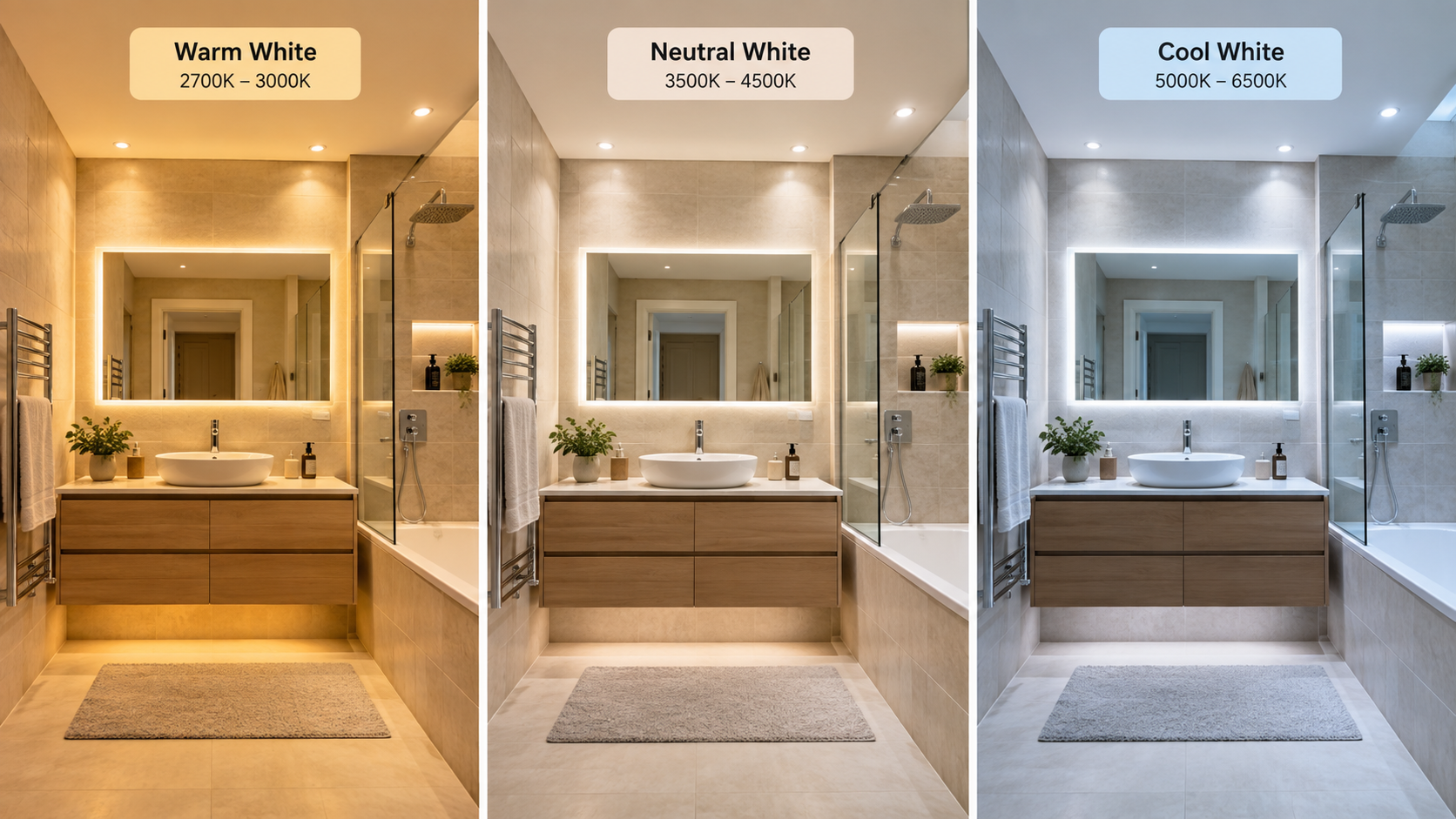
Color temperature affects how the bathroom looks and how colors appear under the light.
It is measured in Kelvin (K).
Generally:
- Warm light creates a softer, more relaxed appearance.
- Neutral light gives a balanced, natural-looking appearance.
- Cooler light can appear brighter and more crisp.
For a bathroom vanity, many homeowners prefer a neutral-to-warm-neutral appearance because it can feel comfortable while still providing clear visibility.
The important thing is consistency. If your vanity has one color temperature and your ceiling fixture has a dramatically different appearance, the room can feel visually disconnected.
Don’t Ignore CRI and Moisture Ratings
Two technical details are easy to overlook when choosing bathroom lighting: CRI and fixture location ratings.
What is CRI?
CRI, or Color Rendering Index, describes how accurately a light source reveals colors compared with a reference light source.
This can matter around a vanity because you want skin tones, makeup, clothing, and other colors to look reasonably natural.
What about damp or wet locations?
Bathrooms contain moisture, so you should not assume that every decorative light fixture is suitable for every bathroom location.
The fixture’s location rating matters. Depending on where the fixture will be installed, you may need a fixture specifically rated for a damp or wet environment.
Always check the manufacturer’s specifications and applicable electrical requirements before installation.
How to Layer Bathroom Lighting Instead of Using One Fixture
One of the easiest ways to improve bathroom lighting is to think in layers.
1. Ambient lighting
This provides general illumination throughout the bathroom.
Examples:
Bathroom ceiling light fixtures and recessed lighting.
2. Task lighting
This provides focused illumination where you perform specific activities.
Examples:
Vanity lighting, bathroom sconces, and appropriately positioned mirror lighting.
3. Accent or decorative lighting
This adds visual interest rather than serving as the primary source of illumination.
Examples:
Pendant lighting or decorative fixtures used in appropriate locations.
Using multiple layers allows you to avoid depending on one fixture for every lighting need.
Common Bathroom Lighting Mistakes to Avoid
Even expensive fixtures can produce a poor result when they are installed without considering the room’s layout.
Using only one ceiling fixture
A single overhead light may leave the vanity area poorly illuminated and can create shadows on the face.
Putting all the light above the mirror
Depending on the fixture and position, overhead-only mirror lighting can create unwanted shadows.
Choosing a fixture that is too small
A small fixture may look lost above a wide vanity and may not provide sufficient coverage.
Choosing lighting based only on appearance
A beautiful fixture is not automatically a practical lighting solution. Consider light output, distribution, dimensions, and location rating.
Ignoring color temperature
Mixing dramatically different color temperatures can make different areas of the bathroom look inconsistent.
Forgetting the fixture’s location rating
Bathroom moisture makes fixture suitability particularly important. Always check the manufacturer’s specifications for the intended installation location.
A Simple Bathroom Lighting Checklist Before You Buy
Before purchasing a fixture, check these points:
- Bathroom size: How large is the space?
- Vanity width: How much area needs task lighting?
- Mirror dimensions: Where can the light be positioned?
- Ceiling height: Is a hanging fixture practical?
- Natural light: How much daylight does the room receive?
- Lighting zones: Do you need separate vanity, ceiling, shower, or tub lighting?
- Brightness: Is the fixture providing enough light for its purpose?
- Color temperature: Will the light create the appearance you want?
- CRI: Will colors appear naturally around the vanity?
- Location rating: Is the fixture appropriate for its installation location?
- Fixture dimensions: Will the light be proportionate to the vanity and bathroom?
If you’re planning a larger bathroom remodel, the available wall and floor space can also influence where fixtures can be installed. For bathrooms with a standard 5-foot wall, you can also see our guide on what bathtub size fits a 5-foot bathroom wall.
How to Choose the Best Bathroom Lighting for Your Home
The best bathroom lighting is not necessarily the brightest fixture or the most decorative one. It is the combination that works with your bathroom’s size, layout, vanity, mirror, ceiling height, and daily routine.
For most bathrooms, start by identifying the areas that need light:
Need clear lighting around the mirror? Consider vanity lighting or bathroom sconces.
Need overall illumination? Add an appropriately sized bathroom ceiling light.
Have a larger bathroom? Use multiple lighting layers rather than relying on one fixture.
Want a decorative statement? Consider pendant lighting where the ceiling height, placement, and fixture rating make it appropriate.
Once you know what each area needs, choosing bathroom lighting fixtures becomes much easier. The goal is to create a bathroom that is bright where you need it, comfortable throughout the room, and visually cohesive with the rest of your space.